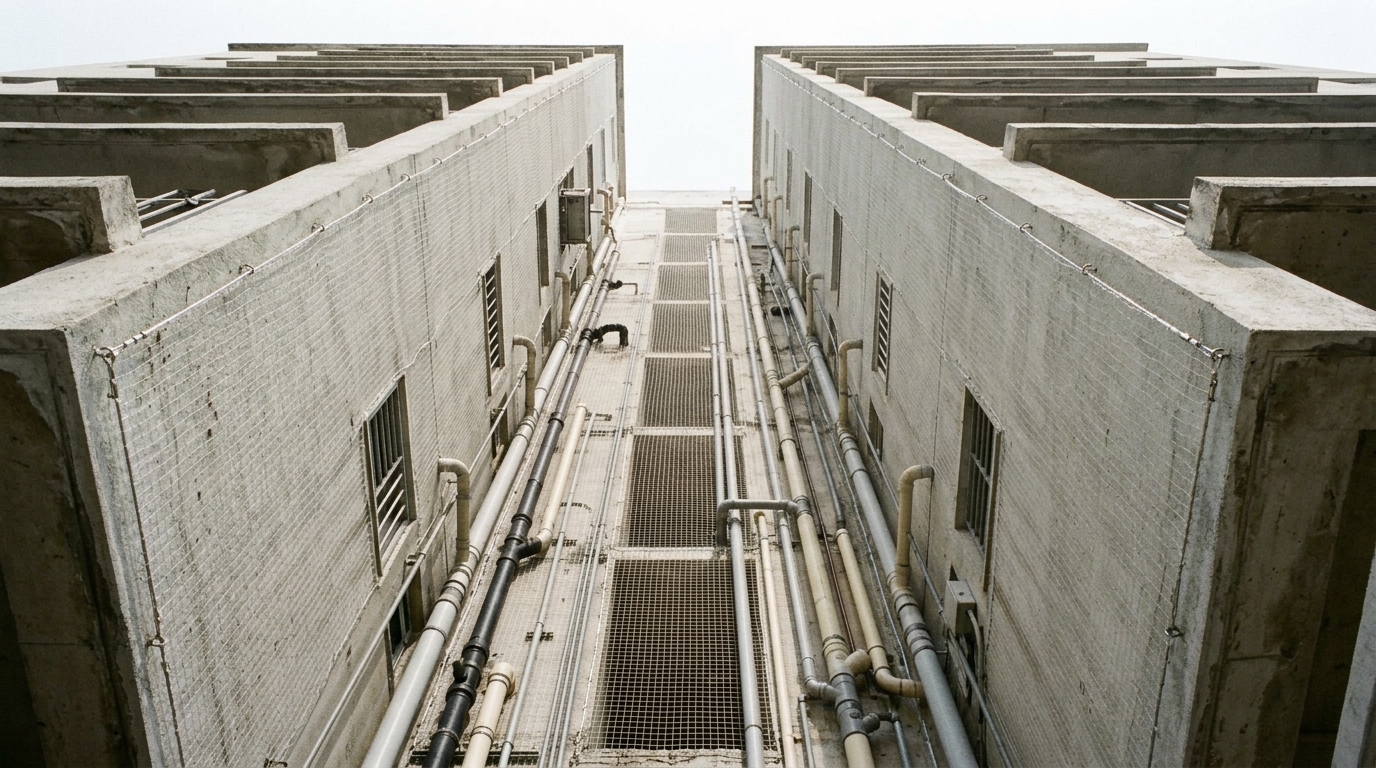
Many apartment residents attempt DIY remedies like shiny CD discs, fake owls, acoustic distress callers, or sticky chemical gels. Pigeons are remarkably resilient birds that become habituated to sensory repellents within 48 to 72 hours. Only an engineered physical barrier guarantees complete, permanent exclusion.
- Step 1: Biohazard Sanitization & Decontamination
- Step 2: Anchor Rigging with Marine-Grade SS 316 Hardware
- Step 3: Precision Net Tensioning & Clamping
- Step 4: Installing Heavy-Duty Service Hatches
- Step 5: Post-Installation Wind & Tension Certification
- Practical Scenario: Multi-Story Shafts in High-Density Localities
Step 1: Biohazard Sanitization & Decontamination
Before any netting is drawn across the shaft, all existing bird presence must be systematically cleared. Pigeons leave biological scent markers that attract other flocks. Our certified crew:
- Clears accumulated droppings, dead carcasses, broken eggshells, and nesting twigs from plumbing ledges.
- Treats surfaces with quaternary ammonium bio-disinfectant sprays to neutralize fungal spores (*Histoplasma* and *Cryptococcus*).
- Flushes drainage channels at the bottom of the shaft to ensure stormwater exits without obstruction.
Step 2: Anchor Rigging with Marine-Grade SS 316 Hardware
The foundation of a reliable duct net is its perimeter wire framework. Poorna technicians drill into concrete RCC structural beams using high-grade anchor bolts spaced every 1.5 to 2 feet:
A 4mm Grade 316 stainless steel wire rope is threaded through all perimeter eyelets. High-capacity turnbuckles (strainers) are tightened to create high drum-tight perimeter tension. This ensures zero gaps where pigeons could slip through the edges.
Step 3: Precision Net Tensioning & Clamping
Next, customized sheets of 100% genuine Garware UV-stabilized copolymer nylon (25mm mesh) are hoisted into position. Each mesh loop along the perimeter wire rope is fastened with pneumatic stainless steel C-hog rings.
Because the net is anchored tautly without sagging, pigeons cannot land or sit on the surface—the net gently rebounds, safely discouraging any roosting attempts.
Step 4: Installing Heavy-Duty Service Hatches
Apartment shafts require periodic maintenance: AC technicians need to service external condensers, and plumbers must reach wastewater soil pipes. To prevent technicians from slicing through the net:
Poorna Enterprises integrates customized, reinforced industrial marine zippers or heavy-duty hook-and-loop flaps directly into the net fabric at technician access points. Once work is completed, the zipper is closed shut, maintaining 100% pigeon-proof integrity.
Step 5: Post-Installation Wind & Tension Certification
Our lead supervisor executes a thorough perimeter tension and alignment check. Every turnbuckle is tightened, excess wire trimmed, and the society secretary or facility manager is issued formal documentation detailing applicable manufacturer material warranty terms.
Immediate physical exclusion of birds from shaft ledges, reduction of new droppings and nesting debris, and protected plumbing and air conditioner lines.
Practical Scenario: Multi-Story Shafts in High-Density Localities
In high-density apartment communities across localities like Anna Nagar, Velachery, and T. Nagar, building duct shafts frequently span 8 to 12 floors with multiple bathroom exhaust vents and split AC outdoor units facing inward. When birds colonize these vertical shafts, feathers and droppings build up on ledges, creating persistent odors and clogging drainage grates.
In a typical multi-tier shaft exclusion, technicians first clean and sanitize accessible ledge surfaces. High-tensile Garware UV-stabilized nylon netting is then secured along the perimeter using stainless steel wire rope and tension turnbuckles, with dedicated zippered access panels installed near AC compressors for future servicing. Once sealed, bird entry is prevented while keeping ventilation open.